
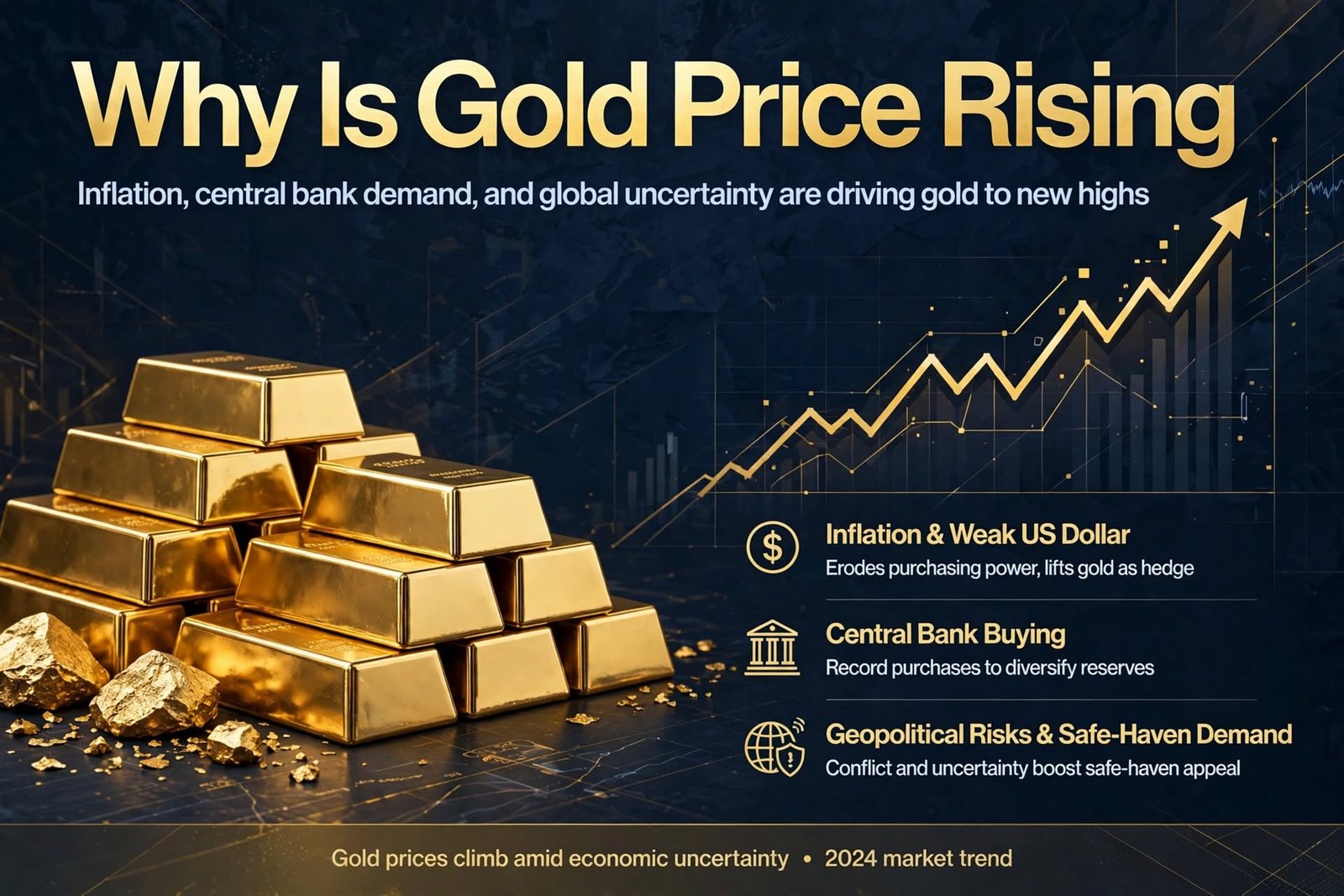
Why Is Gold Price Rising? 6 Real Reasons Behind the Surge

Gold has more than doubled since 2024. It’s set dozens of record highs since 2025, briefly touched nearly $5,600 an ounce in January 2026, and remains one of the best-performing major asset classes of the past three years. For something that pays no dividend, no interest, and produces nothing, that’s a genuinely remarkable run and it raises an obvious question: why?
The short answer most headlines give “central banks are buying gold” is true, but it’s also incomplete, and slightly out of date. The fuller picture involves interest rates, currency dynamics, and a demand story that’s actually been shifting under the surface in 2026, even as the price keeps climbing. Understanding which forces are doing the heavy lifting right now, not just two years ago, matters if you’re trying to make sense of where gold might go next.
This guide breaks down the real, documented drivers behind gold’s rise, including a nuance most surface-level coverage misses: the exact demand story driving gold in 2026 isn’t quite the same one that drove it in 2024 and 2025.
Table of Contents
- The Short Answer
- Reason 1: Central Bank Buying — The Foundational Driver
- The 2026 Twist: Central Bank Buying Has Actually Cooled
- Reason 2: Real Yields and Interest Rate Expectations
- Reason 3: A Weakening U.S. Dollar
- Reason 4: ETF and Retail Investor Demand — 2026’s New Driver
- Reason 5: Geopolitical Uncertainty
- Reason 6: Constrained Mine Supply
- How Analysts Actually Model This: Conviction vs. Opportunistic Buyers
- What Could Slow or Reverse the Rally
- Step-by-Step: How to Think Through Gold’s Price Yourself
- Real-Life Example: Reading a Single Day’s Headline Correctly
- Common Mistakes to Avoid
- Expert Tips for Following This Story Going Forward
- Key Takeaways
- FAQs About Why Gold Prices Are Rising
- Final Thoughts
The Short Answer
Gold’s rise since 2024 reflects several forces reinforcing each other at once: record central bank purchases (though this has cooled in 2026), falling real interest rates, a softer U.S. dollar, surging ETF and retail investment demand, ongoing geopolitical tension, and mine production that hasn’t kept pace with demand.
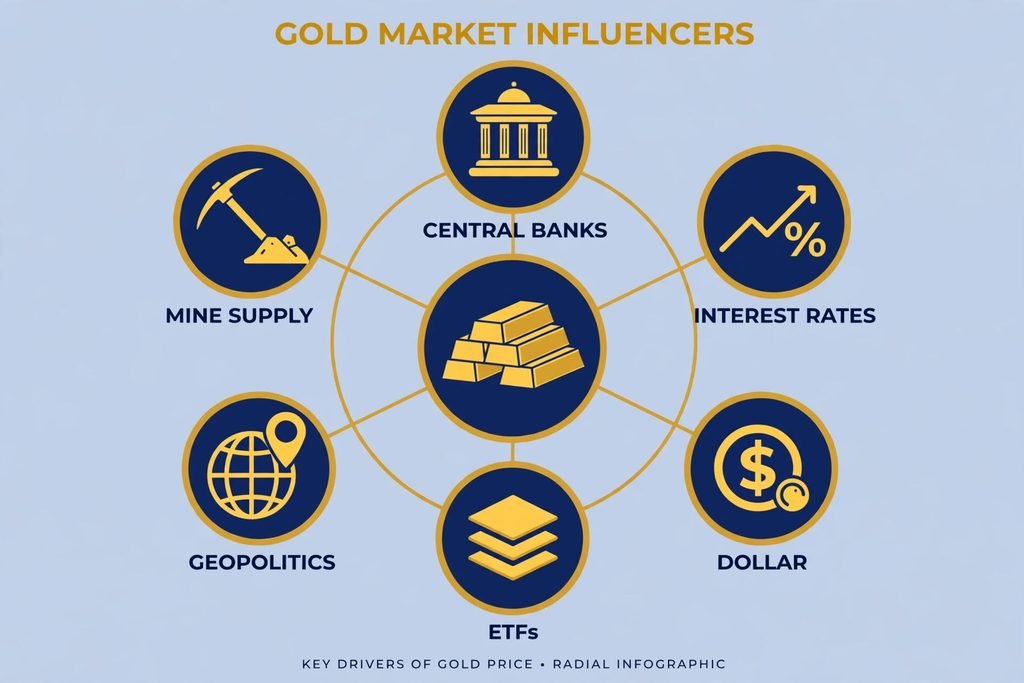
No single factor fully explains the move. What makes this rally unusual is how many of these drivers have been pulling in the same direction simultaneously, for an extended period which is part of why the climb has been so sustained rather than a short-lived spike.
Reason 1: Central Bank Buying The Foundational Driver
What’s Been Happening
Since 2022, central banks worldwide have been buying gold at a historic pace averaging roughly 1,000 tonnes annually from 2022 through 2025, roughly double the pace seen from 2016 to 2020. In a genuinely striking shift, foreign central banks now hold more gold than U.S. Treasuries as a share of their international reserves for the first time since 1996.
Why They’re Buying
Central banks, particularly in countries like China, Russia, India, and other emerging economies, have been deliberately diversifying away from the U.S. dollar as a reserve asset buying gold as a non-sovereign store of value that isn’t subject to another country’s monetary policy or, in some cases, sanctions risk. This is widely described as a structural, multi-year portfolio-diversification trend rather than a short-term trading decision.
The 2026 Twist: Central Bank Buying Has Actually Cooled
This is the part most surface-level “why is gold rising” content misses, and it’s worth understanding clearly.
The Data
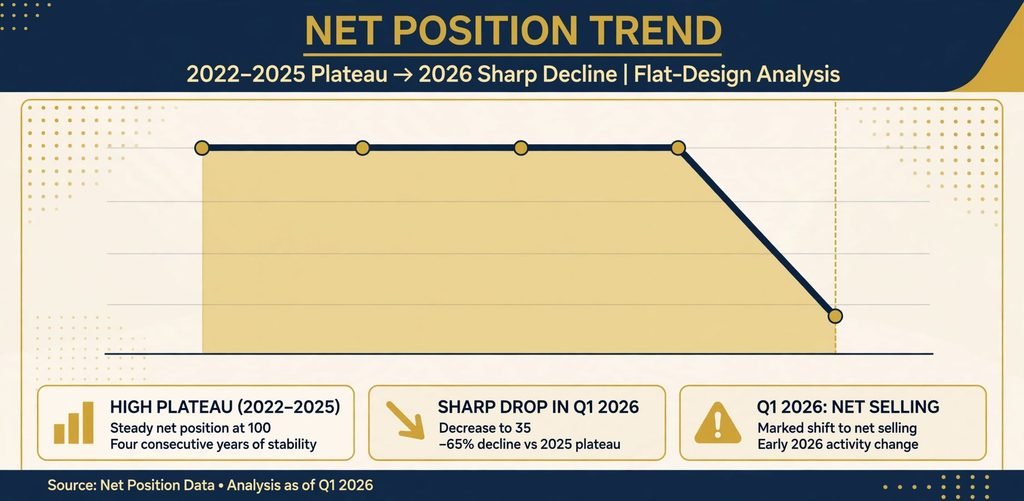
According to J.P. Morgan Global Research, central banks actually sold a net 129 tons of gold in the first quarter of 2026 headlined by Turkey selling 60 tons in March while reported purchases totaled just 16 tons, a sharp drop in momentum compared to the torrid pace of 2021–2025.
Why the Price Kept Rising Anyway
This is genuinely important: if central bank buying alone explained gold’s rise, a slowdown (or net selling) should have caused prices to fall. Instead, gold kept climbing. This tells you the primary driver of gold’s price has been shifting from official-sector buying toward other sources of demand (covered below), even as the headline narrative of “central banks are buying gold” continues to circulate.
A Caveat Worth Noting
The World Gold Council has pointed out that a meaningful amount of central bank gold buying goes unreported, since there’s no mandatory requirement to disclose purchases to the IMF meaning the true current pace of official buying may be somewhat higher than the reported figures suggest. Even so, most analysts agree the momentum has genuinely slowed compared to 2021–2025’s exceptional pace.
Reason 2: Real Yields and Interest Rate Expectations
The Mechanism
Gold pays no interest or dividend, which makes it directly competitive with interest-bearing assets like bonds. The key relationship analysts watch is real yields the return on bonds after subtracting inflation. Historically, gold and real yields have shown a strong inverse correlation: gold tends to rally when real yields fall, and struggle when real yields rise.
Why 2025–2026 Has Favored Gold
A notable feature of the 2025 market was gold posting record gains even during periods of elevated real yields an unusual pattern that suggests other forces (central bank buying, de-dollarization, geopolitical demand) were strong enough to override the historical relationship, at least temporarily. Meanwhile, expectations around Federal Reserve rate cuts have periodically added tailwinds, since falling rates typically reduce the opportunity cost of holding a non-yielding asset like gold.
Reason 3: A Weakening U.S. Dollar
The Mechanism
Gold is priced globally in U.S. dollars. When the dollar weakens against other currencies, gold becomes cheaper for buyers using those other currencies which tends to increase global demand and push the dollar price of gold higher. The relationship works in both directions and has been a consistent, if secondary, contributor to gold’s strength.
Connected to De-Dollarization
The same central bank diversification trend driving Reason 1 also reduces global reliance on the dollar more broadly a slow-moving structural shift that reinforces gold’s appeal as an alternative store of value outside the dollar system.
Reason 4: ETF and Retail Investor Demand 2026’s New Driver
The Shift
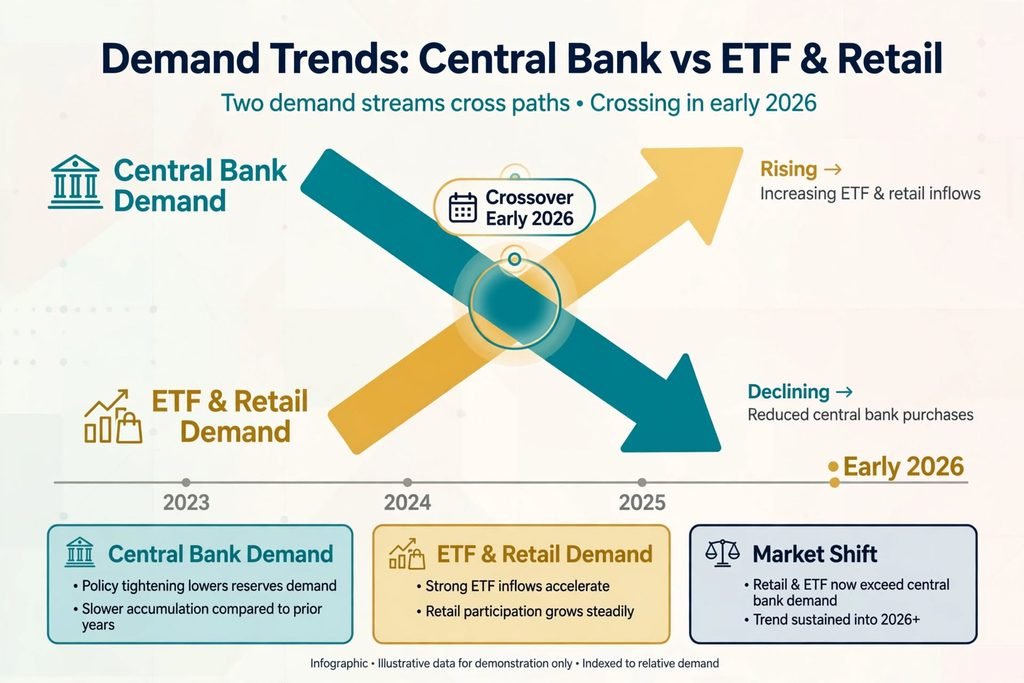
As central bank buying has cooled in 2026, a different source of demand has stepped in to fill the gap: retail and ETF investors. In the fourth quarter of 2025 alone, retail-focused gold ETFs saw inflows equivalent to over 280 tonnes of gold purchases actually eclipsing central bank demand for that period.
Why This Matters
This represents a genuine changing of the guard in gold’s demand story. Analysts at institutions like UBP expect retail investors to be a strong driver of higher prices through 2026, as everyday investors increase their allocation to gold and precious metals more broadly partly driven by concerns about valuation levels in other major asset classes like stocks.
Why Retail Demand Behaves Differently Than Central Bank Demand
Retail and ETF buyers tend to be more price-sensitive and can move faster than central banks, whose purchases are typically slower, more strategic, and less reactive to short-term price swings. This means the character of gold’s demand base and therefore its potential volatility may be shifting as retail investors become a larger share of the buying.
Reason 5: Geopolitical Uncertainty
The Safe-Haven Effect
Gold has a long-standing reputation as a safe-haven asset somewhere investors move money during wars, political instability, or major uncertainty, when currencies and stocks feel riskier by comparison. Ongoing conflicts and diplomatic tensions through 2025 and into 2026 have periodically added short-term spikes on top of the longer structural trends described above.
Why This Is a Secondary, Not Primary, Driver
While geopolitical headlines often coincide with single-day price jumps, most analysts view this as an amplifier on top of the structural trends (central bank diversification, real yields, dollar weakness) rather than the core reason for the multi-year climb. Geopolitical spikes tend to be sharper but shorter-lived than the underlying structural demand shifts.
Reason 6: Constrained Mine Supply
The Supply Side of the Story
Global gold mine production has grown only modestly in recent years commonly cited in the 1–2% annual range creating a relatively fixed supply backdrop against a rising and diversifying pool of demand. Unlike many commodities, gold mining can’t simply ramp up quickly in response to higher prices, since new mines take years to develop.
Why This Reinforces Everything Else
A tight supply picture doesn’t cause a rally on its own, but it means that when demand increases whether from central banks, ETFs, or retail buyers there’s less room for supply to absorb that demand without the price moving. This is sometimes referred to as a “scarcity” dynamic supporting the broader trend.
How Analysts Actually Model This: Conviction vs. Opportunistic Buyers
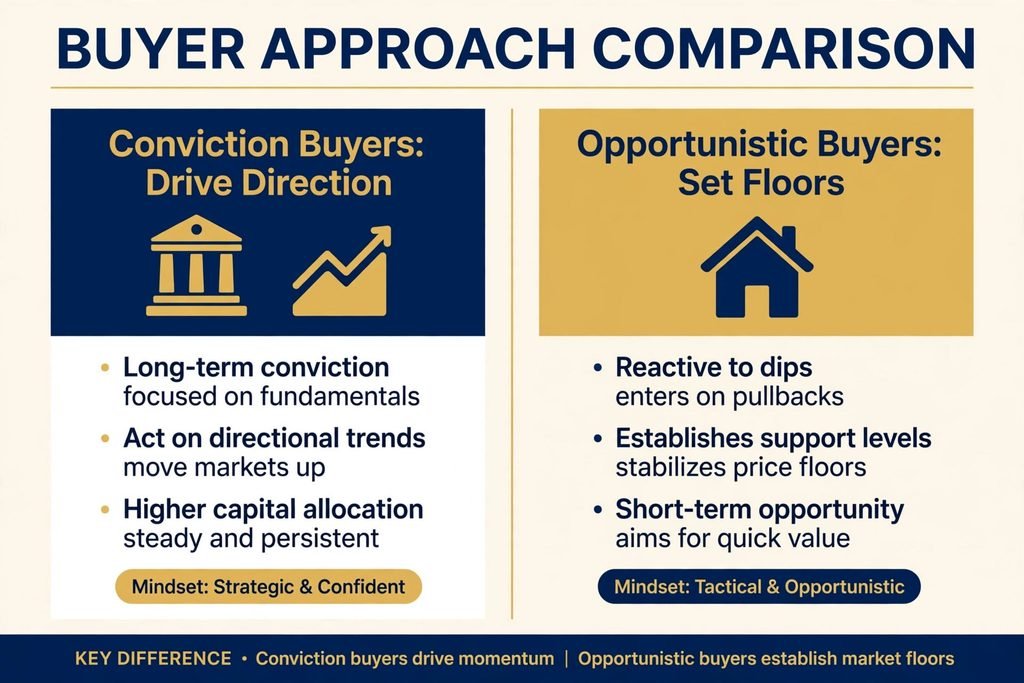
Goldman Sachs Research uses a useful framework for understanding gold’s buyer base, worth knowing if you want to follow this story with more nuance than a headline provides.
Conviction Buyers
These include central banks, ETFs, and larger speculative investors buyers who purchase gold consistently based on a longer-term economic view or hedging strategy, largely regardless of short-term price swings. According to Goldman’s research, every 100 tonnes of net purchases by these conviction holders corresponds to roughly a 1.7% rise in gold’s price making this group the primary driver of price direction.
Opportunistic Buyers
These are typically households, especially in emerging markets, who buy when they believe the price is favorable and pull back when it feels expensive. This group tends to provide a floor under prices during declines and resistance during rapid climbs, rather than driving the underlying trend itself.
Why This Framework Is Useful
Understanding which group is currently driving activity helps explain why the price is moving, not just that it’s moving and it’s part of why analysts pay close attention to the composition of demand (central bank vs. ETF vs. retail), not just the total volume.
What Could Slow or Reverse the Rally
No trend continues in a straight line forever, and several factors could meaningfully cool or reverse gold’s climb:
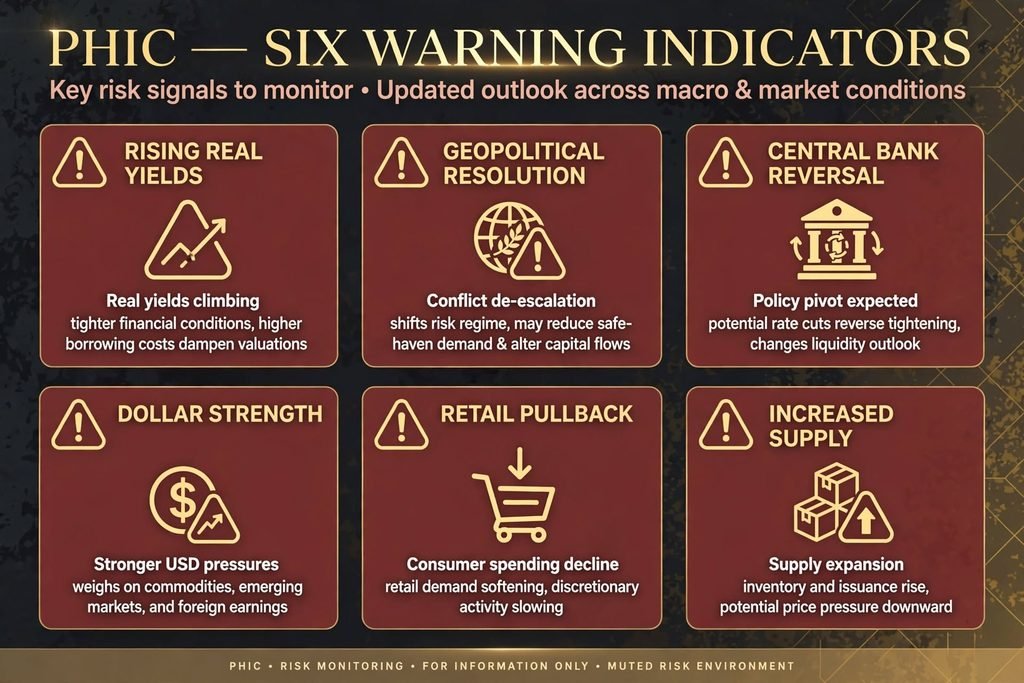
- A sustained rise in real yields, if inflation cools faster than interest rates fall, restoring gold’s traditional inverse relationship with bond returns
- A resolution of major geopolitical tensions, removing a source of safe-haven demand
- A reversal in central bank buying, if the net-selling pattern seen in early 2026 continues or accelerates
- A stronger U.S. dollar, which would make gold more expensive for international buyers
- A pullback in retail/ETF enthusiasm, given this buyer group’s greater price sensitivity compared to central banks
- Increased mine supply, if higher prices eventually incentivize enough new production to meaningfully ease the scarcity dynamic
Step-by-Step: How to Think Through Gold’s Price Yourself
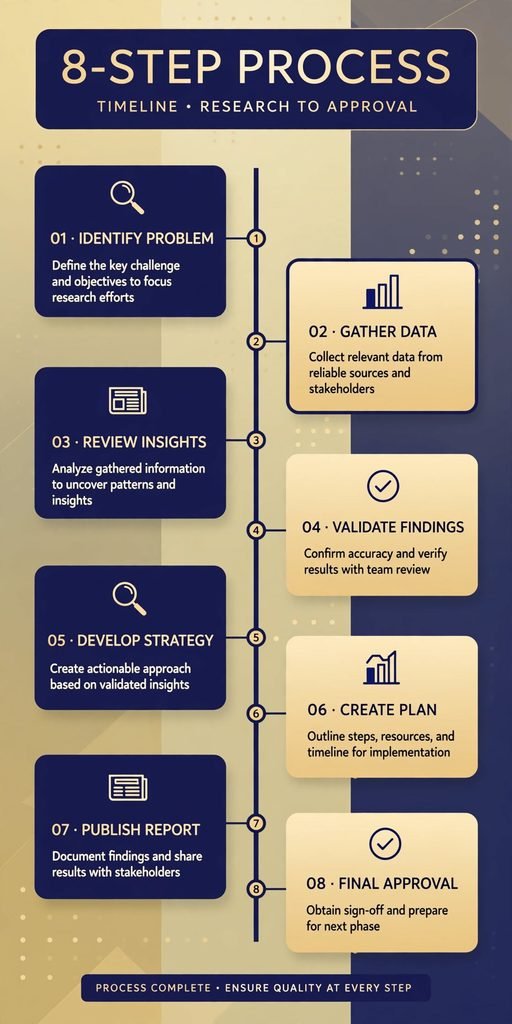
Step 1: Check What’s Actually Driving Recent Moves, Not Just the Price
A single day’s headline number tells you almost nothing about the underlying cause look for the specific driver cited (a Fed announcement, a geopolitical event, a data release).
Step 2: Distinguish Structural Trends From Short-Term Spikes
Central bank diversification and real yield shifts are slow-moving structural trends; a single geopolitical headline is typically a shorter-term amplifier on top of them.
Step 3: Watch the Composition of Demand, Not Just the Total
Whether the recent buying is coming from central banks, ETFs, or retail investors changes how sustainable and how volatile that demand is likely to be.
Step 4: Compare Multiple Forecasts, Not Just One
Major institutions’ 2026 gold price targets have varied meaningfully comparing several rather than anchoring to a single bullish or bearish prediction gives a more balanced picture.
Step 5: Consider the Real Yield Environment
If real yields are falling, that’s traditionally supportive for gold; if they’re rising, that’s traditionally a headwind even if other factors are temporarily overriding the relationship.
Step 6: Factor In Your Own Timeline and Goals
Whether gold’s price story matters to you as a short-term trader or a long-term diversification holder should shape how much weight you put on any single data point.
Step 7: Revisit the Story Periodically, Not Just Once
As this guide shows, the primary driver behind gold’s rise has already shifted once in 2026 (from central banks to ETF/retail demand) the explanation that was accurate a year ago may no longer be the most complete one today.
Step 8: Check a Live Price Source for Any Actual Decision
Understanding the “why” is separate from knowing the current “what” always verify a live price before acting on any specific number.
Real-Life Example: Reading a Single Day’s Headline Correctly
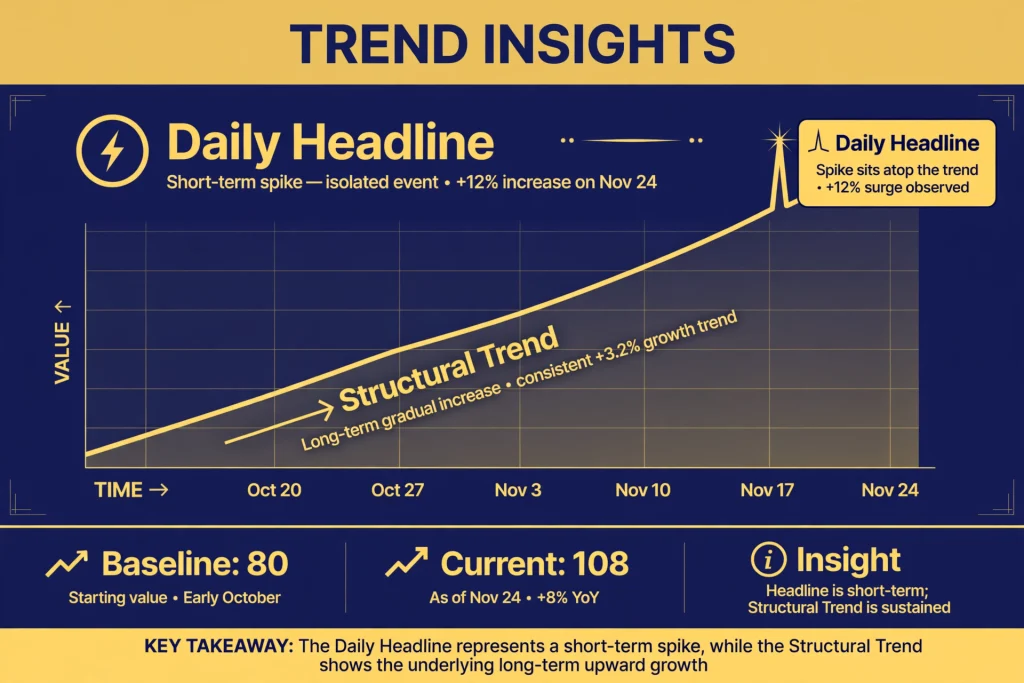
Meet Farrah, who sees a headline: “Gold jumps 2% as investors flee to safe havens amid Middle East tensions,” and wants to understand what it actually means for her modest gold ETF holding.
The surface read: Farrah’s first instinct is to assume gold is rising purely because of the day’s specific geopolitical news.
The deeper look: Rather than stopping there, Farrah recalls that gold’s broader 2025–2026 climb has been driven by a combination of structural forces central bank diversification (even as that specific driver has recently cooled), falling real yields at various points, dollar weakness, and a genuine surge in ETF and retail demand. The day’s geopolitical headline is a real, additional factor but it’s layered on top of, not a replacement for, those longer-running trends.
The distinction that matters: Farrah recognizes that if the geopolitical situation resolves, gold could give back some of that day’s specific gain but the underlying structural demand drivers wouldn’t necessarily disappear along with it. This helps her avoid overreacting to a single news cycle, whether that means panic-selling on a dip or over-committing more money purely because of one dramatic headline.
The takeaway: Understanding the layered nature of gold’s price drivers structural trends plus short-term amplifiers gives Farrah a more accurate framework for interpreting daily news than treating each headline as a complete explanation on its own.
Common Mistakes to Avoid
- Treating “central banks are buying gold” as the complete, current explanation. This was the dominant driver from 2022–2025, but central bank buying has genuinely cooled in 2026, with other demand sources taking a larger role.
- Assuming a single day’s geopolitical headline explains a multi-year trend. Geopolitical spikes are real but typically layer on top of slower-moving structural drivers, not replace them.
- Ignoring the real yield relationship entirely. While gold has recently defied its traditional inverse correlation with real yields at times, this relationship remains a meaningful factor analysts continue to watch closely.
- Anchoring to a single institution’s price forecast. Major banks’ 2026–2027 targets have varied significantly comparing multiple views gives a more balanced picture than following just one.
- Not distinguishing between conviction and opportunistic buyers. These two buyer types behave very differently and have different effects on price direction versus price floors/ceilings.
- Assuming gold only ever rises. Despite the recent multi-year climb, gold has had significant historical periods of decline or stagnation, and several plausible factors could slow or reverse the current trend.
- Overlooking unreported central bank activity. Official reported figures may understate true central bank buying, since disclosure to the IMF isn’t mandatory adding genuine uncertainty to any single data point.
- Not updating your understanding over time. As this guide shows, the primary driver behind gold’s rise has already shifted once within 2026 alone treat any explanation, including this one, as a snapshot that may need revisiting.
Expert Tips for Following This Story Going Forward
- Track World Gold Council quarterly demand trends reports for the most authoritative, detailed breakdown of who’s actually buying gold and in what volume.
- Watch real yield data, not just headline interest rates, since it’s the inflation-adjusted return that has the more direct historical relationship with gold’s price.
- Pay attention to ETF flow data specifically, since this has become an increasingly important, faster-moving demand signal in 2026 compared to the slower-moving central bank data.
- Read multiple major banks’ forecasts side by side rather than anchoring to whichever headline you encountered first.
- Distinguish a single day’s move from the multi-month trend before drawing conclusions about what’s “driving” gold at any given moment.
- Remember that even well-reasoned forecasts have been wrong before treat any specific price target as an informed estimate, not a guarantee.
Key Takeaways
- Gold’s rise since 2024 reflects several forces reinforcing each other: central bank buying, falling real yields, dollar weakness, surging ETF/retail demand, geopolitical uncertainty, and constrained mine supply.
- Central bank buying the primary driver from 2022 through 2025 has genuinely cooled in 2026, with net selling reported in the first quarter, even as the price continued rising.
- ETF and retail investor demand has emerged as an increasingly important driver in 2026, in some periods actually eclipsing central bank purchases.
- Goldman Sachs’ “conviction vs. opportunistic buyer” framework helps explain why some buying drives price direction while other buying mainly sets floors and ceilings.
- The specific explanation for gold’s rise has already shifted once within 2026 understanding the underlying mechanisms, not just memorizing one static answer, gives you a more durable framework for interpreting future headlines.
FAQs About Why Gold Prices Are Rising
1. Why is the price of gold going up so much?
Gold’s rise reflects several reinforcing factors: record central bank buying (though this has cooled in 2026), falling real interest rates at various points, a weaker U.S. dollar, surging ETF and retail investment demand, geopolitical uncertainty, and mine production that hasn’t kept pace with demand.
2. Are central banks still buying gold in 2026?
The pace has genuinely slowed central banks reportedly sold a net 129 tons in the first quarter of 2026, compared to averaging around 1,000 tonnes annually from 2022–2025. However, some purchases go unreported, and most analysts still expect continued, if reduced, structural buying over the full year.
3. What is a real yield, and why does it matter for gold?
A real yield is a bond’s return after subtracting inflation. Gold has historically shown a strong inverse relationship with real yields rallying when they fall and struggling when they rise though this relationship weakened at times during 2025’s exceptional gains.
4. If central bank buying has slowed, why hasn’t gold’s price fallen?
Other demand sources, particularly ETF and retail investor buying, have stepped in to fill the gap in Q4 2025, retail-focused ETF inflows actually exceeded central bank gold purchases for that period.
5. How does the U.S. dollar affect gold’s price?
Since gold is priced globally in U.S. dollars, a weaker dollar makes gold cheaper for buyers using other currencies, which tends to increase global demand and push gold’s dollar price higher, and vice versa.
6. What’s the difference between “conviction buyers” and “opportunistic buyers” of gold?
Conviction buyers (central banks, ETFs, larger speculators) buy consistently based on a longer-term view and primarily drive price direction. Opportunistic buyers (often households in emerging markets) buy when the price feels favorable, mainly providing support during declines rather than driving the trend.
7. Could gold’s price go down from here?
Yes several factors could slow or reverse the rally, including a sustained rise in real yields, a resolution of major geopolitical tensions, a genuine and sustained reversal in central bank buying, a stronger dollar, or a pullback in retail/ETF enthusiasm.
8. Is gold still rising because of the same reasons it was in 2024?
Not entirely. While the foundational drivers (diversification, uncertainty, limited supply) remain relevant, the specific composition of demand has shifted central bank buying’s dominant role from 2022–2025 has given way to a larger contribution from ETF and retail investors in 2026.
Final Thoughts
Gold’s remarkable rise isn’t the result of one single cause it’s the product of several structural and cyclical forces reinforcing each other at once, and importantly, that mix has already changed shape once within 2026 alone. Central bank buying got this rally started and sustained it for years; ETF and retail demand appear to be carrying a larger share of the load now, even as central bank momentum has genuinely cooled.
The most useful takeaway isn’t a single tidy explanation it’s the habit of asking which specific forces are actually at work behind any given headline, and being willing to update that understanding as the story continues to evolve. Gold, like any market, doesn’t move in a straight line forever, and the same structural analysis that explains its rise is exactly what will eventually signal when the trend is genuinely shifting.